The becoming of Evig chair
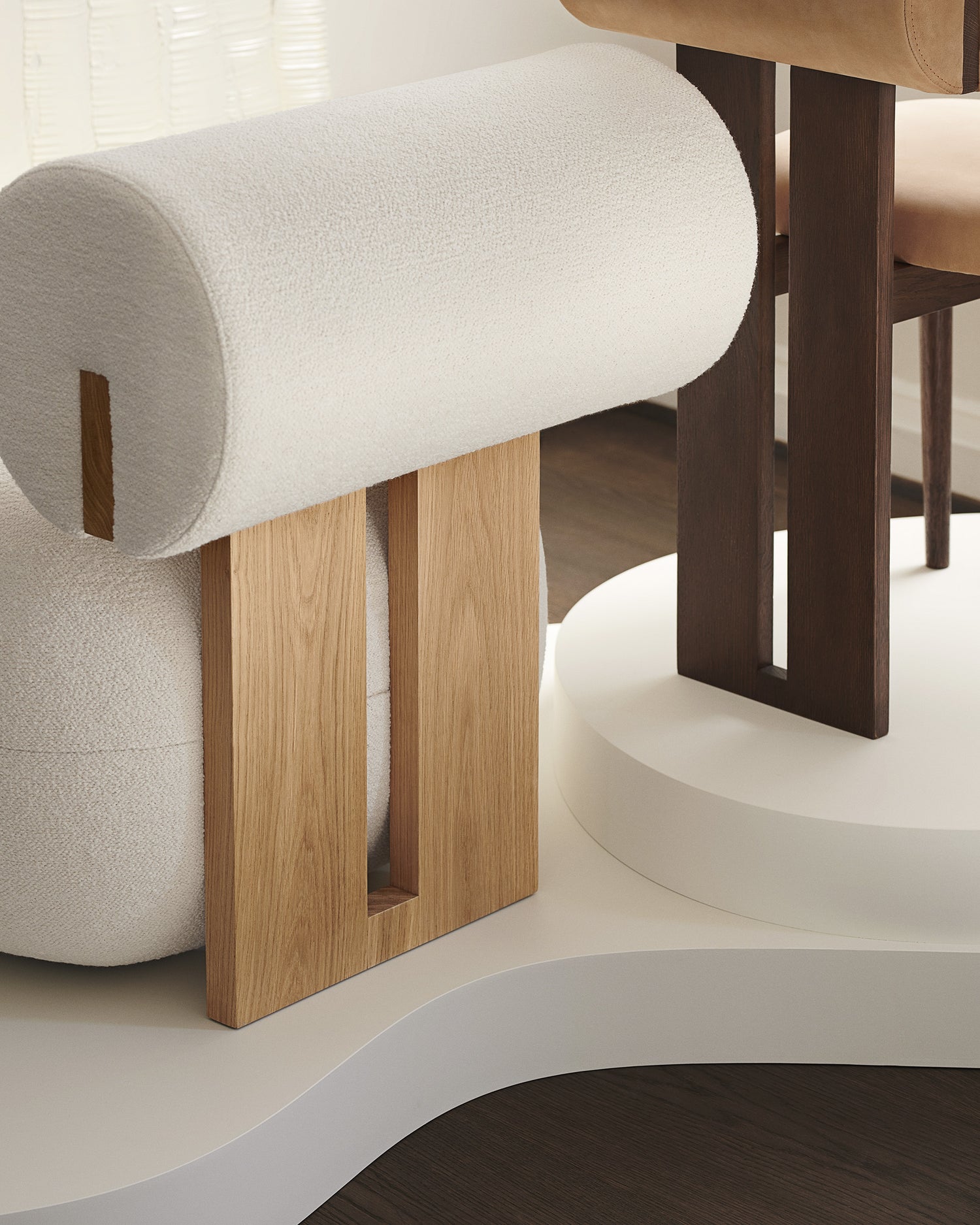
Here stands a finished chair. At first glance, it might look like a simple wooden, stackable chair, but it has something else on its mind. It tells a story about looking at available resources differently, and about how we justify the existence of design in a broader sense, with responsibility toward future generations.
In its expression, it is simple, but in many ways opinionated, as NORR11 designs often are. A design language that does not try to please everyone, and one that often divides opinion. Evig chair carries a point of view. So do the people behind it. And because of that, the process behind its creation becomes a bigger story than simply launching a new stackable wooden chair.

“We entered this process without knowing the outcome in advance. For years, we had wanted to develop a stackable wooden chair, and when the opportunity came to explore how we could do it through a new approach, we were ready to go into it. We don’t put furniture into the world unless we feel it has a right to exist. So it was never given that there would be a finished chair on the other side of this process. But part of NORR11’s identity is to be bold. And if we are to live that out, not only in our design language, we also need to put ourselves at risk and go into projects like this without knowing the answers beforehand,” says Ludvig Kjærulff, Co-CEO at NORR11.
His role as Co-CEO is in many ways a good example of how processes work at NORR11, through close collaboration and co-creation, which has also been central to Evig chair. The chair’s becoming has involved NORR11 employees, production partner Kvist Industries, a new talented designer named Esben Pilgaard Jørgensen, and a research project initiated by Aalborg University Denmark, which actually started the whole thing.


Evig chair is made from a combination of offcuts from both our own production and others, aesthetically rejected oak from Kvist’s production, as well as wood with small holes, traces of insects that have lived in the material.
A large part of the process has been mapping what actually exists in the material stream, what gets sorted out, what gets redirected, and what usually ends up elsewhere in other industries.
Its making requires significantly more work and a different level of care, especially from the production side, where rejected wood needs to be sorted in new ways, offcuts are saved, and the small holes in the wood are filled. It requires a level of time, care and mindset not typically built into a traditional process. Evig therefore becomes an example of how material use can be optimized, while at the same time questioning what we expect furniture to look like, both as an industry and as consumers.

"Color variation and natural irregularities are often sorted out in the furniture industry, but wood is a natural material, and that is what wood looks like. These are nature’s own marks. They are not flaws, but something authentic. We should question whether such traces of nature truly deserve to be rejected,” says Marianne Thompson, Product Manager at NORR11, with more than 30 years of experience in the furniture industry. For her, this has become a personal cause.

Uno Kofod, Product Developer at NORR11 with the same level of experience, adds that the chair is made with the same high structural quality as any other NORR11 product. The wood is processed and treated in the same way, meaning the differences are purely visual, not technical or quality related, and Evig chair also meets EN 16139-L2 standards. First-grade wood does not necessarily mean better furniture, he points out. It often just means more uniform, more predictable and easier to standardize. In design, that is often an aesthetic choice, not always a quality one.

Behind the final design is external designer Esben Pilgaard Jørgensen, described by Ludvig as a “new talent,” an approach NORR11 also continues to focus on.
Even though the design expression of Evig chair might look simple and minimal, its creation has been anything but. Esben describes how it has been necessary to work “backwards” when designing Evig, as all parties involved, especially the production partner Kvist Industries, have simultaneously been researching and mapping which materials were possible to use. Because he wanted the material itself to speak and be the louder part of the design, he focused on keeping the chair’s expression simple, while ensuring it still fits within the existing collection. This way of working has also enabled reuse within the existing collection, without developing new tooling. For example, the molding for the back and seat of Evig is the same as the one used for the NY11 chair.

The name Evig, meaning eternal in Danish, is meant to represent the next generation. In that sense, it holds a deeper meaning, that we as an industry need to rethink material use and reconsider what purpose design should hold, taking responsibility for what we leave behind for the generations that follow.
And according to Linda Nhu Laursen, Associate Professor and Head of Research at the Design Lab, Aalborg University, “having an agenda” is not something new in the Danish design tradition. She explains that we have a long tradition of design carrying intention, and that it has often been a normative part of educating the consumer through our design heritage. While the mid-century agenda was more democratic and societal oriented, she believes that today it should be the planet that deserves attention, which is also where the research-based project initially began.
Nikoline Sander, PhD Fellow at the Design Lab, Aalborg University, emphasizes the importance of focusing on the quality of the wood. That we, as an industry, may be looking at it the wrong way. Discarded wood is not “waste,” but a virgin material that holds the same quality as wood with fewer structural or color variations. Like Marianne, she highlights that these structures simply tell the story of the wood’s life.
But moving from theory into practice, and ultimately creating a commercial reality, has required courage, as Ludvig previously described. And even though we now stand with a finished product, new questions continue to arise, and many unknowns remain. For example, the resources used for Evig are not unlimited. And whether consumers will embrace its point of view remains a real concern.
But as Evig launches during 3daysofdesign 2026, being bold and taking that leap fits closely with this year’s theme for NORR11, Just Because.
A theme described as NORR11’s lived expression, where an underlying thought of “fear of judgment” exists, but being bold enough to stand in your own expression anyway. In that sense, the launch of Evig aligns closely with where NORR11 is heading. A period of maturation, where the vision of “sparking curiosity” has been the starting point of this entire project.
Evig chair holds meaning and carries something to say, just like the people behind its creation. A chair with a point of view. And although the process is still very new, and the chair very young, it holds the hopeful potential to grow into the world and gently shift it for the better, much like the next generations.